
When Trend-Following Underperforms
 8 min read
When Trend-Following Underperforms
At first glance, the equity curve of TiltFolio Adaptive looks smooth and steady, almost serene. It rises over time with fewer deep drawdowns than most portfolios, and the long-term trajectory is impressive. But as with anything that appears simple and elegant, the reality is more nuanced beneath the surface.
Trend-following, by design, doesn’t always work in the short term. And sometimes, it can feel like it isn’t working at all.
The Nature of the Beast
Over more than a century of market data, stocks have been the strongest-performing asset class most of the time. Occasionally, other assets, such as bonds, commodities, or gold, take the lead for a few years or even a decade.
TiltFolio Adaptive is designed to rotate into whichever major asset class is strongest at any given moment. This includes stocks, bonds, gold, commodities, or a long-volatility proxy. In theory, this allows investors to benefit from long-term momentum trends across all major asset classes.
In practice, however, this also means that TiltFolio Adaptive will often fail to keep up with the strongest-performing single asset class, especially when that asset is stocks. Since most investors and media coverage focus on the S&P 500, periods of underperformance can feel especially painful.
Backtested data since 1993 shows that TiltFolio Adaptive underperformed the S&P 500 in roughly half of all years. In the social media era, where everyone seems to be “beating the market” (often by using leverage or taking concentrated bets), this can take a real mental toll.
Why Trend-Followers Fall Behind
The explanation for this short-term underperformance is straightforward but often misunderstood. There are two primary reasons a trend-following system like TiltFolio Adaptive lags behind during certain phases:
1. Trend-followers miss the beginning of every move
By definition, trend-followers only buy something after it has already started rising. This means they will always miss the initial part of any major rally.
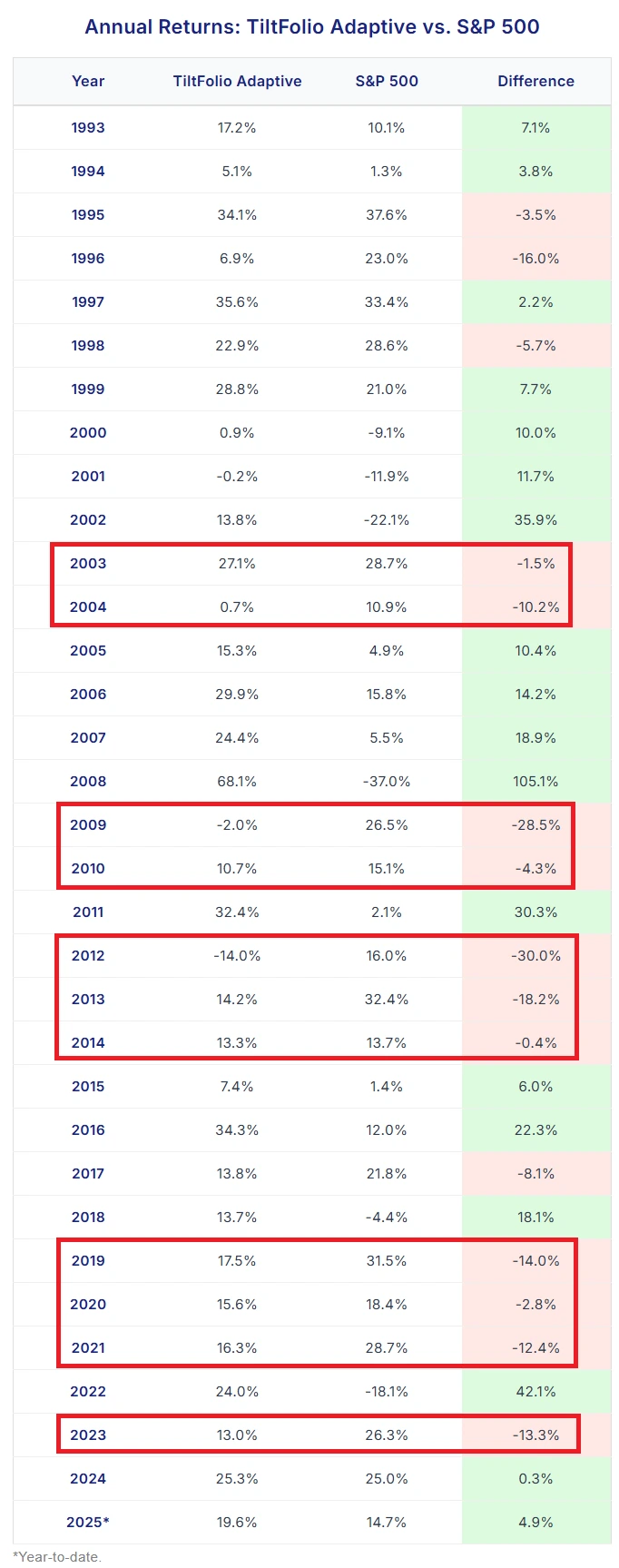
Take 2009 as an example. Following the global financial crisis, equities rebounded sharply from their March lows as central banks unleashed unprecedented stimulus. But TiltFolio Adaptive, like most long-term trend systems, didn’t meaningfully rotate into equities until early 2012, three years after the bottom.
This is by design. Trend-followers are not in the business of “catching bottoms.” They are in the business of catching established trends and riding them for as long as possible. That means missing early gains, but also avoiding catastrophic losses when trends reverse.
2. Whipsaws are unavoidable
Trend-following systems can also get caught in periods of whipsaw, rapid reversals that cause frequent small losses. When a market briefly loses its upward momentum, the system may rotate out, only to buy back in at a higher price later.
This problem becomes most visible during raging bull markets, when every dip is bought aggressively. A trend-following system that exits on a pullback may re-enter after missing a sharp rebound, lagging behind passive investors who simply held through the noise.
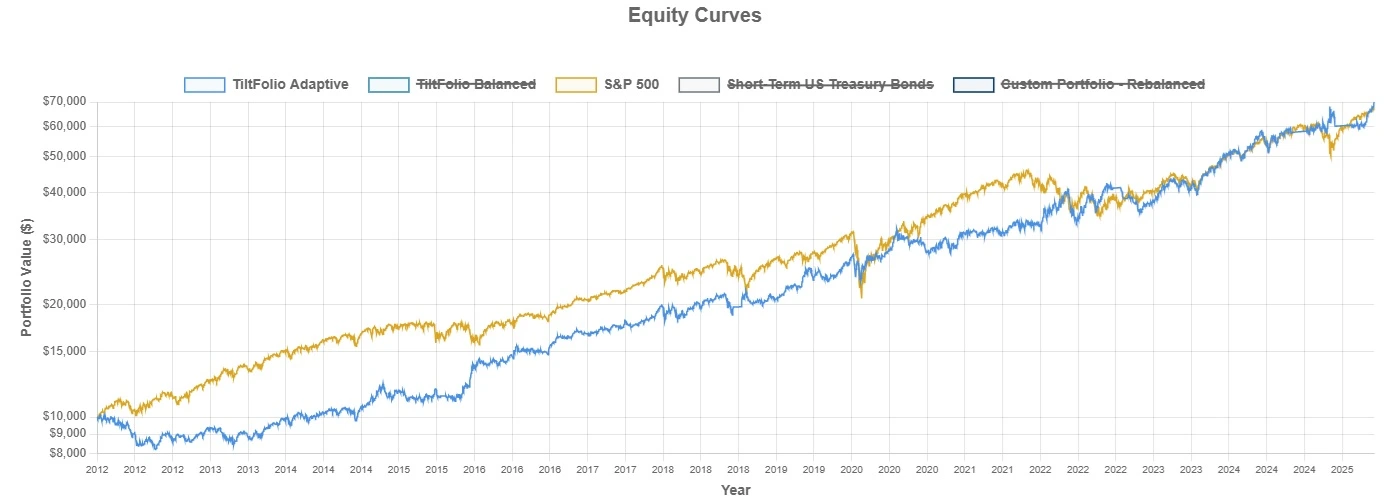
For instance, in April 2012, TiltFolio Adaptive rotated into stocks but was forced out again by June, just before markets rallied strongly. It spent the rest of the year trying to recover through gold and bonds, neither of which performed well. Only in early 2013 did it regain its footing.
Such frustrating cycles are not a sign of failure. They are simply the cost of participating in a rules-based system designed to protect capital first, and compound it second.
When the Pain Feels Personal
The hardest period for any trend-follower isn’t the drawdown itself, it’s the psychological drag of watching everyone else get rich while your system seems broken.
Consider TiltFolio Adaptive’s toughest stretch, beginning in 2012. After its poorly timed entry into stocks, it underperformed the S&P 500 by 30% in 2012 and another 18% in 2013. While the S&P 500 surged roughly 50% over that period, TiltFolio Adaptive actually lost 2%.
For any investor who joined the system at the start of 2012, it took nearly eight years, until the COVID-19 pandemic in 2020, to catch up with the S&P 500.
That kind of patience is almost superhuman. And yet, it’s also what separates those who benefit from long-term compounding from those who chase whatever is working today.
Trading Fatigue and Emotional Discipline
When trend-following works well, it feels effortless. Trades are rare, your portfolio rises quietly month after month, and the discipline of sticking to a system feels easy.
But when markets churn sideways and signals flip rapidly, it feels like death by a thousand cuts. You’re constantly trading, falling behind the benchmark, and questioning everything you once believed about data and discipline.
This is when most investors quit, just before the next big trend begins.
The Bigger Picture: Cycles and Convexity
Periods like 2012, 2013 are the price of admission for long-term outperformance. Over decades, TiltFolio Adaptive’s logic, buying strength, avoiding weakness, has compounded into powerful results. But that compounding only works if you survive the dull, discouraging stretches in between.
Every trend-following system lives and dies by its ability to cut losses quickly and let winners run. That asymmetry, or convexity, is what produces long-term alpha. It also means accepting many small, annoying losses along the way.
Ironically, the same mechanics that make trend-following difficult are what make it profitable. Most investors can’t endure underperforming for years, so they give up, leaving the opportunity to those who stay the course.
The Social Media Illusion
In the age of screenshots, charts, and daily performance bragging, sticking to a methodical strategy feels almost unnatural. Everyone online seems to be compounding faster, trading smarter, and buying the dip with perfect timing.
What most people forget is that short-term brilliance rarely compounds. Many so-called outperformers rely on leverage, speculative positions, or lucky streaks that eventually mean-revert.
TiltFolio Adaptive doesn’t play that game. It’s not designed to win every year or even every market phase. It’s designed to survive every regime and thrive over full cycles. That difference matters far more than a single year’s bragging rights.
Learning from the Hard Years
Every investor who embraces trend-following must make peace with one truth: there will be multi-year periods where you look wrong.
But those same periods are when the system strengthens your discipline and filters out emotional decision-making. When the next major trend arrives, whether in gold, commodities, or equities, you’re already positioned to ride it.
Since 2022, TiltFolio Adaptive’s real-world performance has proven this dynamic once again. After rotating into gold in mid-2024, it captured a significant portion of the metal’s renewed bull market, even as many equity-heavy investors lagged.
Markets will always cycle between frustration and vindication. The key is staying in the game long enough for the vindication to arrive.
Conclusion: The Price of Reliability
Trend-following doesn’t fail when it underperforms in the short term. It fails when investors abandon it.
TiltFolio Adaptive isn’t built to be perfect; it’s built to be durable. It sacrifices early gains and tolerates whipsaw to deliver a far more valuable outcome: long-term compounding with lower drawdowns and higher reliability.
Periods of underperformance are not bugs in the system, they are the necessary pauses between major opportunities.
In that sense, trend-following is less about predicting the future and more about surviving it.
How TiltFolio Works Series
This post is part of the “How TiltFolio Works” series. Explore all posts in the series:
- TiltFolio Explained: A Smarter Alternative to 60/40 Portfolios
- Explaining TiltFolio Through Car Brands
- Why the Modern World Needs TiltFolio
- Why TiltFolio Balanced Is the Foundation
- The Ancient Origins of Portfolio Diversification
- TiltFolio Balanced as a Market Barometer
- When Simple Beats Sophisticated
- Decades of Perspective: What TiltFolio Balanced Teaches Us About the Future
- Building a Simple Trend-Following System
- Beyond Moving Averages: Why Volatility Trends Matter More Than You Think
- How TiltFolio Adaptive Differs From Traditional Trend-Following
- Will Trend-Following Keep Working?
- When Trend-Following Underperforms
- How to Avoid Curve-Fitting in Trend-Following
- The “Secret” to the Best Risk-Adjusted Returns: Correlations
- From Rollercoaster to Escalator: Finding Your Investing A-ha Moment
- TiltFolio’s Main Edge: Reliability That Compounds
- How to Stay Committed to an Investment Plan