What Is Money and Why Societies Create It
 7 min read
What Is Money and Why Societies Create It
Money is one of humanity’s greatest inventions.
It allows billions of strangers to cooperate, trade, and plan for the future. It provides a common language for measuring value, making contracts, and allocating resources across time.
Yet despite its importance, most investors rarely stop to ask a basic question:
What exactly is money?
Open almost any economics textbook and you’ll find the same definition: a medium of exchange, a unit of account, and a store of value.
While technically correct, that definition doesn’t explain why money exists in the first place, or why understanding money is essential to understanding financial markets.
To understand how global markets actually work, and why we build investing systems at TiltFolio, it is helpful to view money through a different lens. Economist Reuven Brenner describes money as a yardstick: a common measuring tool that allows millions of people to cooperate, trade, and plan for the future.
Once you see money more as a measuring tape, many features of the modern financial system begin to make much more sense.
Why Money Was Created
Imagine a world without money.
You’re a shoemaker who wants apples. Finding someone selling apples isn’t enough. You also need to find someone who wants a new pair of shoes at exactly the same time.
Economists call this the double coincidence of wants, and it is one of the fundamental limitations of barter.
The problem extends beyond finding trading partners. Without a common unit of account, every good must be priced relative to every other good. In an economy with just 1,000 products, that means nearly 500,000 different exchange rates.
Money solves this problem elegantly.
Instead of comparing every good against every other good, everyone agrees to measure value using a single unit. Suddenly, hundreds of thousands of exchange rates collapse into a single list of prices.
Whether societies used gold, silver, shells, or even cigarettes in prisoner-of-war camps, money emerged because it dramatically reduced the friction of economic activity.

Salt served as ancient money because it was scarce and useful. The word "salary" comes from the Latin salarium, meaning "salt money."
Planning Across Time
Money does far more than make trade easier.
It allows societies to plan across time.
An entrepreneur can borrow money today to build a factory that won’t produce anything for several years. A family can save for retirement. A business can sign contracts extending decades into the future.
All of these activities depend on trust.
Money serves as the common measuring stick that allows people to compare costs, prices, wages, and investments over time. Like a ruler used by engineers, its usefulness depends on remaining reasonably stable.
If the length of a ruler changed every few months, designing a bridge would become nearly impossible.
The same principle applies to money.
Why the Supply of Money Keeps Growing
If stability is so valuable, why does the supply of money tend to expand over time?
Part of the answer lies in the nature of modern economies.
Growing economies generally require expanding credit. Banks create new deposits when they lend. Governments frequently run budget deficits. Central banks are expected to stabilize recessions, financial crises, and banking systems.
Each of these forces tends to increase the supply of money and credit over long periods.
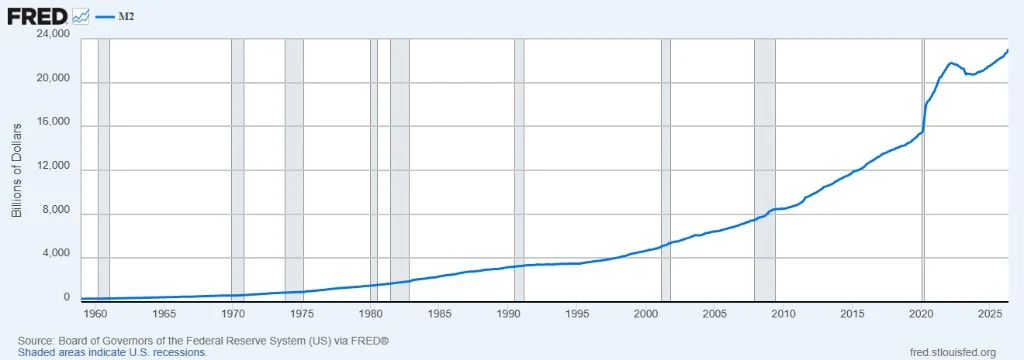
U.S. M2 money supply from FRED, Federal Reserve Economic Data, St. Louis Fed
Unfortunately, modern societies often go a step further, creating more money and credit than is ultimately needed to facilitate trade and productive investment.
Once an economy has sufficient liquidity to function efficiently, additional money does not necessarily create proportionately more real wealth. Instead, it increasingly finds its way into speculative activities, such as financial and real assets.
Whether one agrees entirely with this interpretation or not, the historical trend is difficult to ignore.
Since the collapse of the Bretton Woods system in 1971, money, credit, and global financial assets have expanded dramatically. Over the same period, gold has appreciated substantially.
This is one reason many investors view gold not simply as a commodity, but as a monetary hedge. This is certainly how we see things at TiltFolio. Unlike currencies, gold cannot be created through policy decisions. Its supply grows slowly and predictably, making it an asset that many investors turn to when they are concerned about the long-term purchasing power of money.
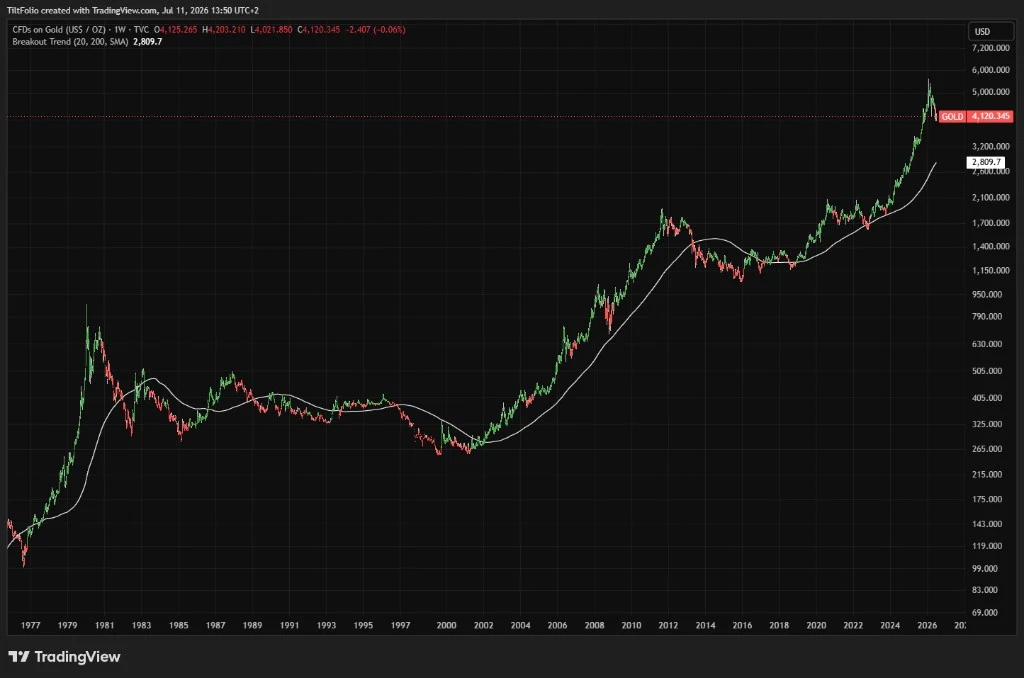
Gold price in USD per ounce, weekly chart from TradingView
Of course, gold is not a perfect investment. It can underperform for years or even decades. But its unique monetary properties explain why it has remained part of financial systems throughout human history. We explore this in more detail in Gold’s Role as a Monetary Yardstick.
For investors, this has important implications.
Money itself does not build factories, invent new technologies, or increase productivity. But when excess liquidity exists within the financial system, it rarely remains idle. It continually searches for a home, moving between asset classes as economic conditions change.
Where the Money Goes
As money and credit accumulate within the financial system, investors continuously reallocate capital in search of the best opportunities.
Which asset class benefits most depends on the economic environment.
During periods of strong economic growth, equities often attract the largest inflows. During recessions or financial stress, government bonds may become more attractive. During periods of persistent inflation or declining confidence in fiat currencies, investors frequently gravitate toward assets such as gold or commodities.
These shifts in leadership are a normal feature of financial markets. Capital is constantly moving, repricing assets as expectations, risks, and economic conditions evolve.
Most investors spend enormous amounts of time trying to predict exactly when inflation will rise, when central banks will change interest rates, or what policymakers will do next.
Those questions are important, but they are also extraordinarily difficult to answer consistently.
How TiltFolio Thinks About Markets
TiltFolio was never designed to predict the future.
Instead, it is built around a simpler observation: capital is constantly moving between asset classes as economic conditions change.
Rather than forecasting where those flows will go next, TiltFolio seeks to identify where they are already occurring and allocate accordingly.
TiltFolio Balanced approaches this through strategic diversification across multiple asset classes. It assumes that no one can reliably predict which asset will perform best in advance, so it maintains exposure to a broad range of opportunities.
TiltFolio Adaptive takes a different approach. Rather than maintaining fixed allocations, it systematically shifts toward the asset classes demonstrating the strongest sustained trends while reducing exposure to those that are weakening.
Both systems begin from the same principle.
Financial markets are shaped by millions of individual decisions, changing economic conditions, and the continual movement of capital. No one can forecast those forces perfectly.
But investors do not need perfect predictions to build a disciplined investment process.
The Bigger Picture
Money was one of humanity’s greatest innovations because it allowed strangers to cooperate, businesses to invest, and societies to plan for the future using a common measure of value.
Modern financial systems are vastly more complex than the barter economies where money first emerged, but the underlying principle has not changed.
Money remains the measuring stick through which economic activity is organized.
For investors, the challenge is not predicting every change to that measuring stick.
It is building a portfolio capable of adapting as capital moves through an ever-changing financial system.
That is the philosophy behind TiltFolio.