TiltFolio's First Year of Live Performance: A Review and What Comes Next
 8 min read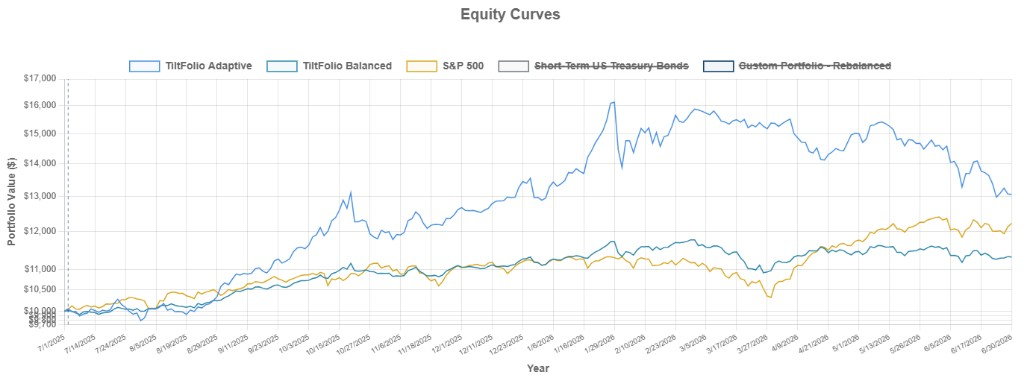
TiltFolio’s First Year of Live Performance: A Review and What Comes Next
At the end of last year, following exceptionally strong performance, I wrote that investors should expect more modest returns going forward. Both TiltFolio systems are inherently mean-reverting: periods of outperformance tend to be followed by more ordinary results, while periods of weaker performance often create the conditions for stronger future returns.
This runs directly against human nature. After a strong year, investors naturally expect more of the same. After a difficult period, many conclude that a strategy has “stopped working” and begin searching for something new.
Looking back at TiltFolio’s first full year as a live investment newsletter, the results largely played out as expected. Returns were respectable in absolute terms, but the S&P 500 remained exceptionally strong, making it difficult for either system to improve upon its risk-adjusted performance.
A Mixed First Year
Twelve months of live performance is still a very small sample, but it is long enough to evaluate whether the systems behaved as intended.
TiltFolio First Year Live Performance
Equity curve generated from the Performance page
TiltFolio Adaptive, the trend-following system, returned 31.0% over the past twelve months. While this comfortably exceeded the S&P 500’s 22.5% return, it did so with significantly higher volatility (25.8% versus 12.7%) and a larger maximum drawdown (-19.5% versus -8.9%).
TiltFolio Balanced, the strategic buy-and-hold portfolio, returned 13.4%, with a maximum drawdown of -7.2% and annualized volatility of 9.2%. Historically, TiltFolio Balanced has aimed to deliver lower absolute returns than equities while producing a smoother investment experience. During this unusually strong equity bull market, however, the S&P 500 delivered both higher returns and better risk-adjusted performance.
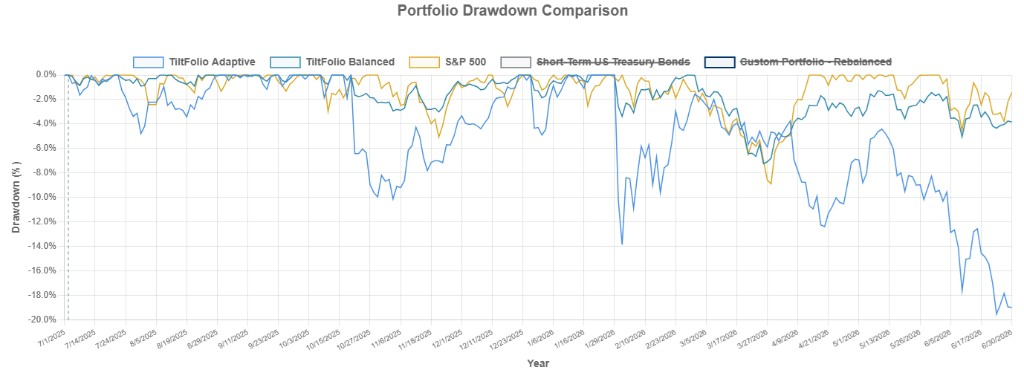
Even a portfolio combining both systems equally (the Custom Portfolio – Rebalanced portfolio) produced the same total return as the S&P 500 (22.5%) without improving upon its volatility or drawdown characteristics.
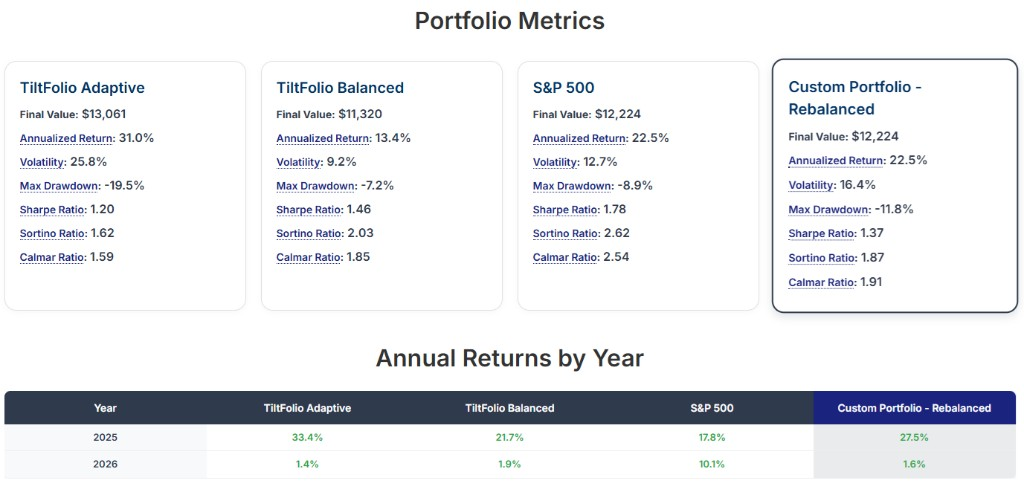
Viewed objectively, TiltFolio’s first live year was mixed. TiltFolio Adaptive achieved absolute outperformance, but not superior risk-adjusted performance, while TiltFolio Balanced performed largely as expected during an environment that heavily favored a concentrated allocation to US equities.
Why Performance Looked This Way
The biggest driver of results this year was gold.
The gold bull market continued far longer than I expected, delivering gains of more than 20% through the end of February. Since then, however, gold has experienced a sharp correction of roughly 30% as an exceptionally strong advance ultimately reversed.
TiltFolio Adaptive exited gold at the beginning of March, avoiding much of the initial decline. As volatility normalized, however, the system re-entered gold in May before another leg lower unfolded, resulting in meaningful losses during June.
Like any investment system with risk management overlays, TiltFolio Adaptive exits positions when volatility moves beyond acceptable levels. TiltFolio Balanced, by contrast, maintained its strategic allocation and has largely traded sideways as weakness in both bonds and gold offset gains elsewhere.
Gold’s Role in a Portfolio
Many investors ignore gold entirely or allocate only a small portion of their portfolios to it. I believe this is a mistake.
Gold remains one of the most effective long-term hedges against currency debasement. At the same time, it is entirely capable of underperforming for extended periods. Between 1980 and 1999, for example, gold returned -3.2% annually, losing purchasing power for nearly two decades.
This is precisely why TiltFolio Balanced limits its strategic gold allocation to 20%. Gold serves an important role within a diversified portfolio, but it should not dominate one.
TiltFolio Adaptive approaches gold differently. Rather than maintaining a permanent allocation, it owns gold only while the asset continues to demonstrate leadership relative to other opportunities. When those trends weaken, the system rotates elsewhere.
Why has gold struggled this year?
One possibility is that markets are beginning to price in a more challenging macroeconomic environment. Historically, gold tends to underperform when monetary policy becomes tighter through higher real interest rates or reductions in money supply. Recent comments from Federal Reserve Chair Kevin Warsh, however, suggest policymakers are unlikely to pursue dramatically tighter policy than under Jerome Powell.
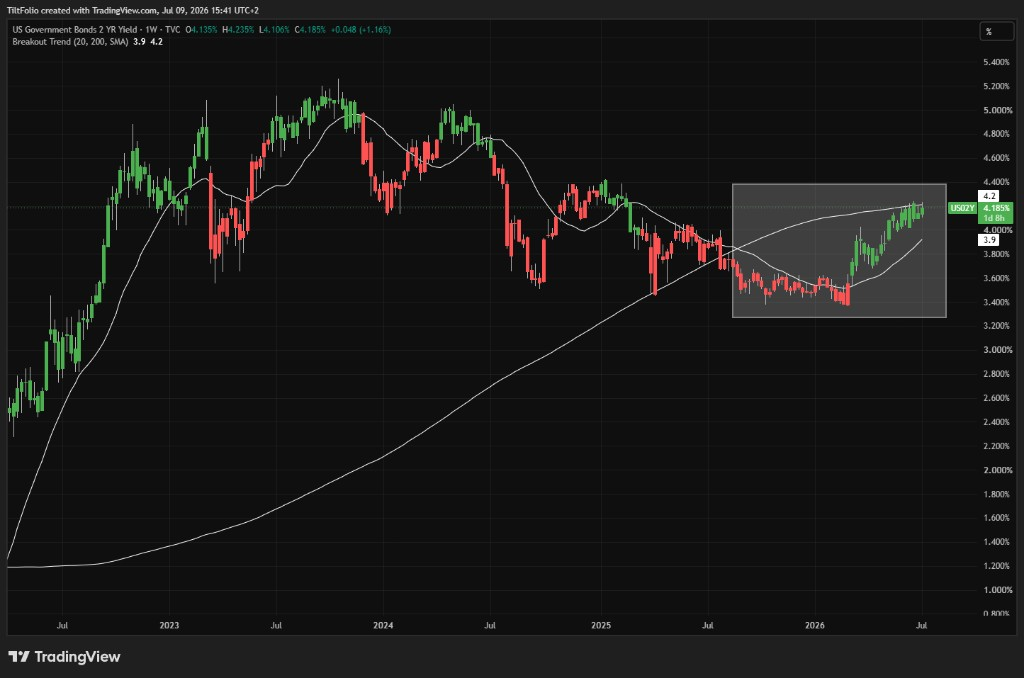
2-year yields rise as markets price in higher future interest rates
Instead, markets may be anticipating a different risk: rising energy prices leading to persistent inflation and forcing central banks to keep interest rates higher than previously expected. While this remains only one possible interpretation, the combination of falling gold prices and rising short-term interest rates is worth monitoring.
Importantly, TiltFolio Adaptive does not attempt to forecast these outcomes. It simply responds to changing market leadership as new trends emerge.
Performance in Context
It’s easy to look at TiltFolio’s first year and conclude that the systems underperformed.
If the goal is to improve upon the S&P 500’s risk-adjusted returns every single year, that simply did not happen.
However, context matters.
Over the past twelve months, the S&P 500 returned 22.5%, experienced a maximum drawdown of just -8.9%, and realized annualized volatility of 12.7%. Over the past thirty-three years, the same index has produced annualized returns of approximately 11%, while experiencing a maximum drawdown of -55.3% and annualized volatility of 18.3%.
In other words, this has been an unusually favorable period for US equities.
If bull markets never ended, every diversified portfolio would eventually underperform a portfolio invested entirely in stocks. There would be little reason to own bonds, gold, commodities, or systematic investment strategies at all.
History suggests otherwise.
The environments that make diversification appear unnecessary are often the same environments that leave investors most vulnerable when conditions eventually change.
What Comes Next
At the beginning of the year, I wrote that TiltFolio Balanced was unlikely to repeat its exceptional 2025 performance because financial assets had become stretched well above their long-term trends. Historically, these environments have been associated with more modest forward returns.
That assessment has not changed.
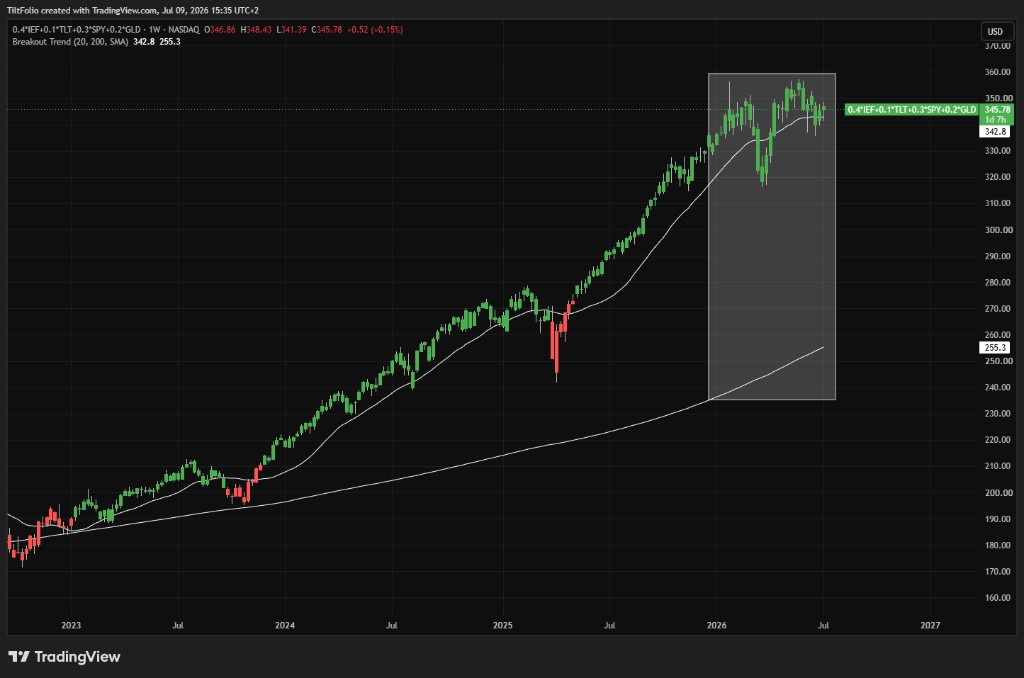
A portfolio with bonds, stocks, and gold stretches far above its 200-week moving average
Financial assets remain extended by historical standards, making it difficult to expect another year of exceptional returns across stocks, bonds, and gold simultaneously. Whether the next major shift ultimately takes the form of deflation, stagflation, or simply weaker equity returns is impossible to know in advance.
Fortunately, predicting the future has never been TiltFolio’s objective.
TiltFolio Balanced remains diversified across multiple asset classes and is designed to weather a wide range of market environments over long investment horizons.
TiltFolio Adaptive is different. Rather than forecasting economic outcomes, it follows observable market trends. History suggests the system performs best when leadership changes and traditional buy-and-hold investing becomes more challenging. If market conditions become less favorable for equities, TiltFolio Adaptive is designed to rotate toward whichever asset classes demonstrate the strongest sustained trends.
One year of live performance is far too little to draw meaningful conclusions about any investment strategy. Even so, this first year has reinforced an important lesson: different market environments reward different approaches.
The objective has never been to outperform in every calendar year.
The objective is to build investment systems capable of navigating full market cycles with discipline, consistency, and without requiring investors to predict what comes next.