
Building a Simple Trend-Following System
 9 min read
Building a Simple Trend-Following System
In previous posts, we explored how combining three major asset classes: bonds, stocks, and gold, creates an ideal foundation for long-term investors. This combination forms the basis of TiltFolio Balanced, a portfolio that prioritizes reliability over excitement. It does not promise thrilling short-term returns, but it does offer something far more valuable: consistency.
When weighted by volatility, this blend of assets has delivered remarkably stable results over the past 50 years. It has never had two consecutive losing years, and it rises steadily through most economic cycles. For most individuals and families, such reliability is all that is required to build long-term wealth. My personal view is that TiltFolio Balanced should serve as the core financial investment for anyone who values peace of mind over constant market tracking. It is simple to follow, historically resilient, and highly likely to generate positive returns over any two- to three-year period.
However, for those of us who enjoy the process of building systems, the next question naturally arises:
Can we improve upon buy-and-hold?
That is the focus of this post. We will examine how a very simple trend-following system (constructed with only a few basic rules) can potentially enhance returns while retaining the logic and transparency that define TiltFolio’s philosophy.
1. From Buy-and-Hold to Active Allocation
The starting point is TiltFolio Balanced. It allocates across bonds, stocks, and gold, creating a diversified base that reflects long-term economic cycles. The system we will build today takes those same three asset classes and introduces a single layer of decision-making: trend and momentum.
The goal is not to trade frequently or time markets perfectly, but to respond to major shifts in leadership among these asset classes. Instead of always holding all three, this system invests in the one that is both trending higher and showing the strongest relative performance.
Here are the exact rules:
• The available assets are U.S. Treasury bonds (10-year), gold, U.S. stocks (S&P 500), and cash.
• Any asset trading above its 10-month moving average is eligible for allocation.
• Allocate 100% of capital to the eligible asset with the strongest 10-month rate of change (momentum).
• At the start of each month, check whether the current holding remains both above its 10-month average and the strongest performer. If not, rotate accordingly.
That is it. Four rules, no forecasts, and no curve-fitting.
This type of model (often referred to as a “dual filter” trend-following system) has been studied extensively across global markets and decades of data. Its power lies in simplicity. By allocating to the strongest uptrend and avoiding assets in downtrends, the system naturally reduces exposure during recessions or major bear markets.
2. Performance Across Half a Century
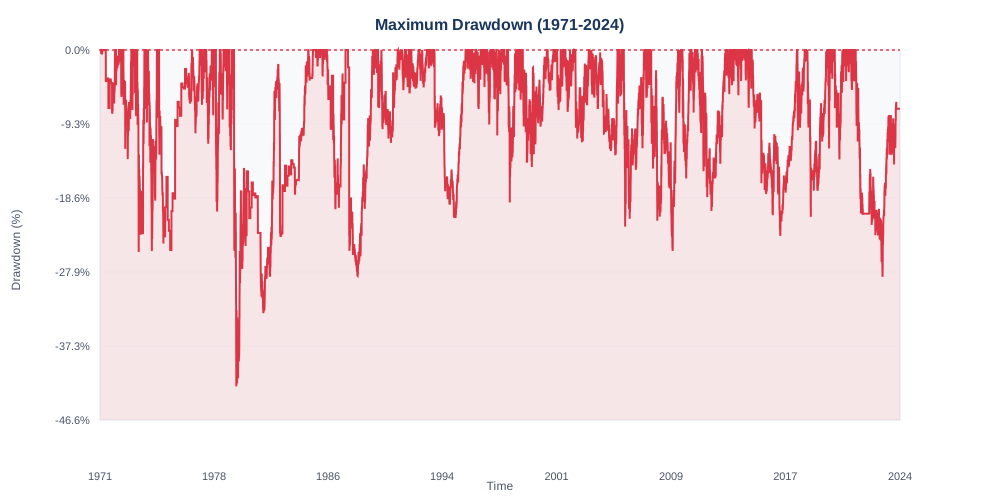
The backtested results for this simple system, from 1971 through 2024, are as follows:
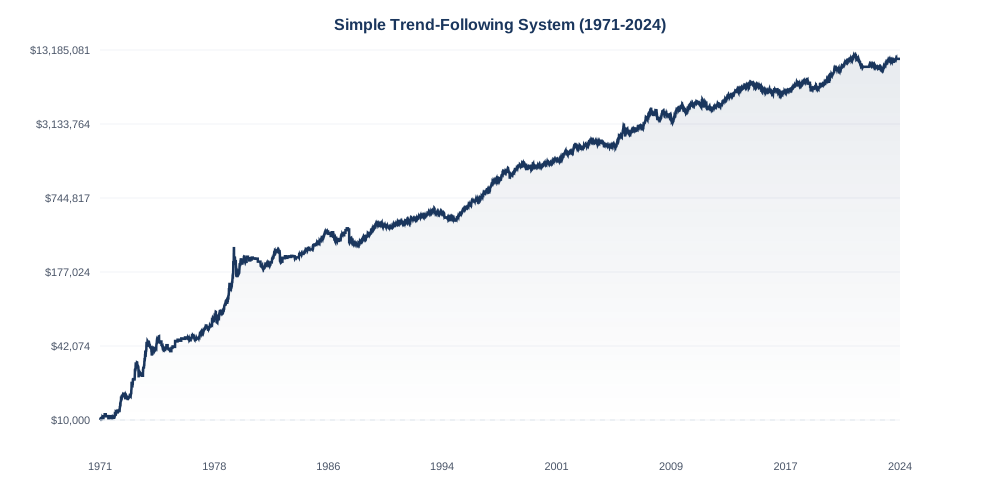
• Annualized return: 13.9%
• Annualized volatility: 17.3%
• Maximum drawdown: –42.3%
By comparison, TiltFolio Balanced achieved over the same period:
• Annualized return: 9.2%
• Annualized volatility: 7.4%
• Maximum drawdown: –18.2%
The improvement in return is substantial, but so is the increase in volatility and drawdowns. Returns rise by roughly 50%, but volatility and drawdowns rise by a greater multiple. In other words, the system delivers higher performance at the cost of higher emotional discomfort.
This trade-off between return and risk is not unique to this model. It is the natural outcome of concentrating exposure in the strongest trend rather than diversifying across several asset classes. Over the long run, such concentration can be rewarding, but it also requires a greater ability to tolerate temporary losses.
3. Comparing to Professional Trend-Followers
To understand how this simple system stacks up against institutional trend-following strategies, it is helpful to look at the SocGen Trend Index, which tracks the performance of leading trend-following Commodity Trading Advisors (CTAs).
According to a report by DUNN Capital Management, which manages one of the oldest and most respected CTA programs, trend-following’s true benefit lies not in short-term returns but in its diversification value. Trend-following strategies often exhibit negative correlation to equities and positive skewness, meaning they tend to make large gains during market crises and smaller losses during stable periods.
From January 2000 to June 2025, the SocGen Trend Index reported:
• Annualized return: 5.0%
• Annualized volatility: 13.4%
• Maximum drawdown: –58.4%
• Correlation to S&P 500: –38%
• Annualized skew: +0.8
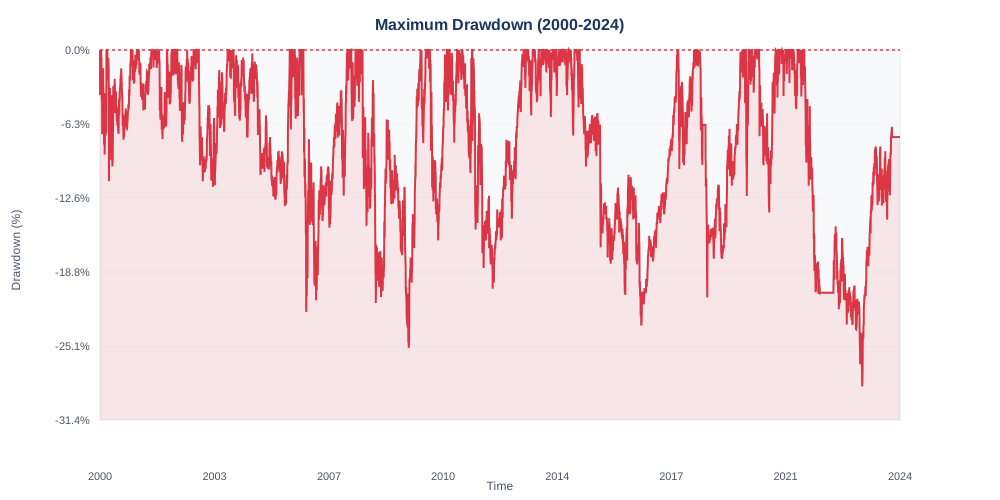
Now let us compare that with the same simple three-asset trend-following system during the same period (2000–2024):
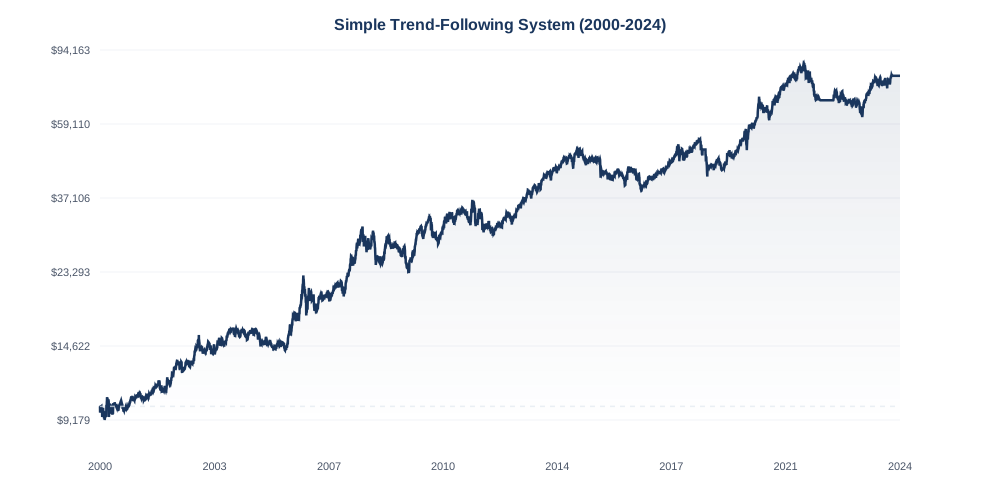
• Annualized return: 8.7%
• Annualized volatility: 14.9%
• Maximum drawdown: –28.6%
• Correlation to S&P 500: +22%
• Annualized skew: –0.1
The results are instructive.
While this simplified system does not have the negative correlation or positive skew of professional CTAs, it still achieves a strong return profile with far less complexity and cost. A 22% correlation to the S&P 500 is modest, and the slightly negative skew is surprisingly good considering the simplicity of the rules.
Most importantly, the system’s long-term risk-adjusted performance is superior. It captures the essence of trend-following: cutting losses, following strength, and adapting to market regimes, without requiring leverage, derivatives, or complex execution.
4. Why Simplicity Works
Many investors assume that sophisticated systems must be superior, but in practice, simplicity tends to be more robust. Complex systems rely on many parameters that can become obsolete as market structures evolve. Simple systems, on the other hand, focus on the behaviors that have remained consistent for centuries.
Long-term trends exist because human psychology does not change. Investors underreact to new information, creating early trends, and then overreact as momentum builds. This behavioral tendency is amplified by institutional constraints and central bank policy.
When central banks intervene heavily (whether through quantitative easing, rate cuts, or liquidity injections), they can inadvertently strengthen trends rather than weaken them. After the 2008 financial crisis, such interventions created a powerful multi-year uptrend in both gold and equities. In 2025, a similar dynamic appears to be playing out again, with gold leading global assets in anticipation of future money creation.
A system that simply follows the strongest trend will naturally capture such structural shifts without needing to predict them.
5. Lessons from Simulated Results
The simple system described here is not TiltFolio Adaptive. It does not include risk controls, volatility targeting, or diversification enhancements that exist in the proprietary model. However, it demonstrates that the core principle of trend-following: allocating to what is rising and avoiding what is falling, can be implemented with only a few rules and still achieve remarkable historical results.
Over half a century of data, this minimal framework produced higher returns than buy-and-hold, while maintaining logical transparency. The cost is emotional: higher drawdowns and more pronounced underperformance during certain bull markets.
Yet this emotional cost is the very reason trend-following continues to work. Most investors cannot tolerate watching a system deviate from the benchmark for years at a time. As a result, the discipline required to stay invested becomes a form of edge.
6. The Takeaway
If TiltFolio Balanced represents stability, this simple trend-following system represents adaptability. It rewards patience during extended trends but demands discipline during reversals.
For most investors, the lesson is not to abandon buy-and-hold, but to understand how even basic rule-based systems can complement it. By following clear, time-tested principles, one can participate in long-term gains without the burden of constant decision-making.
The system’s strength lies in its transparency and timelessness. It is not the result of optimization or curve-fitting, but of acknowledging how markets have always behaved.
And while it may not be as refined as TiltFolio Adaptive, it captures the same essence: the ability to rise above noise, stay aligned with strength, and build wealth through consistency rather than prediction.
How TiltFolio Works Series
This post is part of the “How TiltFolio Works” series. Explore all posts in the series:
- TiltFolio Explained: A Smarter Alternative to 60/40 Portfolios
- Explaining TiltFolio Through Car Brands
- Why the Modern World Needs TiltFolio
- Why TiltFolio Balanced Is the Foundation
- The Ancient Origins of Portfolio Diversification
- TiltFolio Balanced as a Market Barometer
- When Simple Beats Sophisticated
- Decades of Perspective: What TiltFolio Balanced Teaches Us About the Future
- Building a Simple Trend-Following System
- Beyond Moving Averages: Why Volatility Trends Matter More Than You Think
- How TiltFolio Adaptive Differs From Traditional Trend-Following
- Will Trend-Following Keep Working?
- When Trend-Following Underperforms
- How to Avoid Curve-Fitting in Trend-Following
- The “Secret” to the Best Risk-Adjusted Returns: Correlations
- From Rollercoaster to Escalator: Finding Your Investing A-ha Moment
- TiltFolio’s Main Edge: Reliability That Compounds
- How to Stay Committed to an Investment Plan